Why the First Five Years Matter: How Everyday Experiences Build Your Child’s Developing Brain
Before your child walks into a kindergarten classroom, an incredible amount of growth has already taken place. They have learned how to communicate, build relationships, solve problems, move their body and make sense of the world around them.
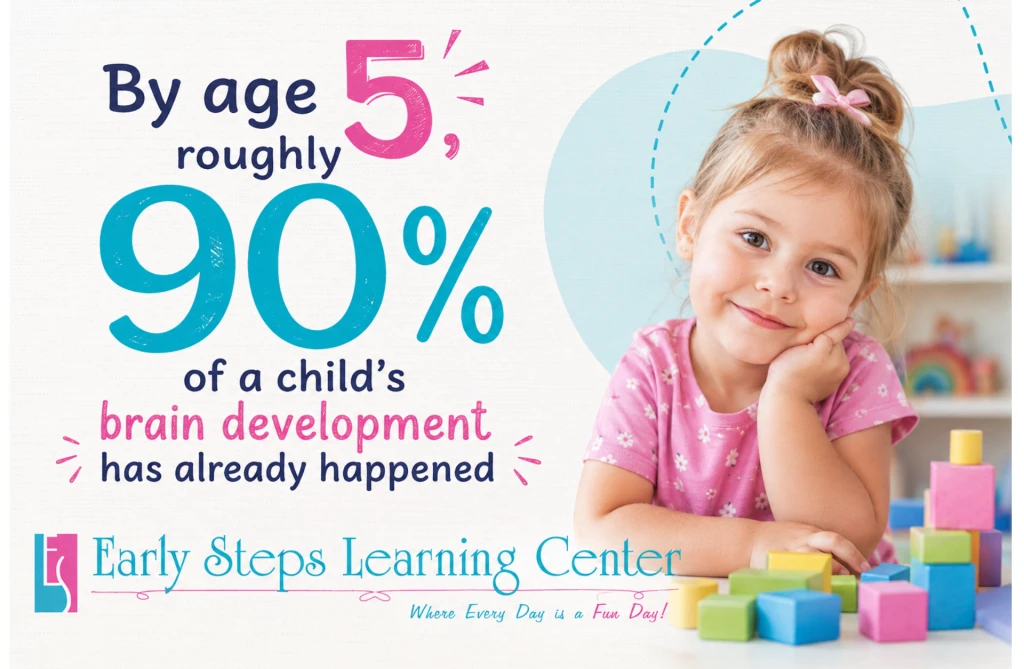
You may have heard the widely shared statistic that approximately 90% of brain development happens by age five. A more precise way to understand it is that a child’s brain reaches about 90% of its adult size during these early years. At the same time, the brain is rapidly building and strengthening the connections that support language, movement, learning, behavior and emotional development.
That information can sound like pressure. It may leave parents wondering whether every activity needs to be educational or whether missing the “right” experience could put a child behind.
The science is much more encouraging: Young brains grow through ordinary, responsive moments. A conversation during snack, a favorite book read again, a puzzle that requires patience, active outdoor play and a reassuring hug after a difficult goodbye can all support healthy development.
At Early Steps Learning Center, we build those meaningful moments into every day.
The First Five Years Are a Foundation, Not a Deadline
The brain does not stop growing when a child turns five. Children, teenagers and adults continue learning and forming new connections throughout life.
What makes the first five years so important is the remarkable speed of early development. The Center on the Developing Child at Harvard University explains that more than one million new neural connections can form every second during the first few years. Early experiences help shape the basic architecture upon which more complex skills are built.
Think of early childhood as the foundation of a house. A strong foundation does not determine every detail of what will eventually be built, but it provides the stability needed for future learning, relationships and well-being.
Parents do not need to create a perfect childhood. Children need safe relationships, consistent care and frequent opportunities to talk, play, move, explore and try again.
1. Responsive Relationships Help Build the Brain
One of the most important ingredients in early brain development is not a particular toy, program or app. It is a responsive relationship with a caring adult.
Harvard researchers describe these back-and-forth exchanges as “serve and return.” A baby babbles, points, reaches or cries. A caregiver responds with eye contact, words, a smile or a comforting touch. The child “serves,” and the adult “returns.”
These everyday interactions help strengthen the brain connections involved in communication, emotional well-being and social development.
In an early learning classroom, responsive care may look like:
- Comforting a child who is upset
- Responding to a baby’s sounds and expressions
- Naming what a child is seeing, doing or feeling
- Celebrating effort and small milestones
- Maintaining consistent routines and expectations
When children trust that the adults around them will respond, they feel safer exploring, taking age-appropriate risks and learning from new experiences.
2. Conversation Creates the Foundation for Language
Children begin learning language long before they can hold a conversation. Talking, singing and reading together expose them to sounds, rhythm, vocabulary and the natural back-and-forth of communication.
Language-building moments do not need to be formal lessons. They happen when an adult:
- Narrates a routine: “We are washing our hands before lunch.”
- Reads a favorite story for the tenth time
- Sings songs and nursery rhymes
- Asks an open-ended question and gives the child time to answer
- Expands on a child’s words: “Yes, that is a big, yellow bus.”
Real conversation is especially valuable because children are not simply hearing words. They are learning that communication has meaning and that their ideas deserve a response.
3. Play Turns Curiosity Into Learning
To a young child, play is serious work. The American Academy of Pediatrics explains that play supports planning, organization, emotional regulation, social skills and healthy brain development.
When children stack blocks, pour water, squeeze play dough, create pretend stories or work through a puzzle, they are experimenting with cause and effect. They are also practicing focus, flexibility and problem-solving.
Helpful play experiences include:
- Water and sand exploration
- Textured toys and sensory materials
- Blocks, puzzles and open-ended building materials
- Art, finger painting and play dough
- Pretend play with classmates and teachers
Children do not need an adult to solve every challenge immediately. A little productive struggle gives them time to test an idea, make an adjustment and discover that they are capable of finding solutions.
4. Repetition and Routine Strengthen New Skills
Adults may become tired of the same song, story or game, but repetition serves an important purpose for young children. Repeating an experience helps the brain strengthen connections and gives children another opportunity to understand, remember and participate.
Predictable routines also support emotional security. When children know what comes next, they can spend less energy managing uncertainty and more energy engaging with the people and activities around them.
Consistency can include:
- A familiar arrival and goodbye routine
- Regular times for meals, rest and active play
- Songs or visual cues that prepare children for transitions
- Revisiting important concepts throughout the week
- Clear, age-appropriate classroom expectations
A routine does not need to be rigid or perfect. Its value comes from helping children feel prepared, secure and ready to participate.
5. Movement Supports More Than Physical Development
Running, climbing, balancing, jumping and dancing help children build strength and coordination, but the benefits extend beyond physical skills.
Active play gives children opportunities to practice body awareness, spatial reasoning, listening, turn-taking and self-control. It can also help them release energy and return to quieter learning activities more prepared to focus.
Movement-rich experiences may include:
- Outdoor play and running games
- Climbing, balancing and jumping
- Music and movement activities
- Simple obstacle courses
- Fine-motor activities such as drawing, stringing and building
Children develop through how they play, learn, speak, act and move. A strong early childhood program makes room for all of those areas rather than focusing on academics alone.
What High-Quality Early Childhood Education Looks Like
When families search for child care or preschool near Richmond Heights or Wickliffe, they often want to know what truly supports development.
Look beyond worksheets and expensive toys. A high-quality early learning environment should include:
- Nurturing teachers who respond to each child’s needs
- A structured, developmentally appropriate curriculum
- Hands-on learning and sensory exploration
- Daily conversation, stories, music and movement
- Consistent routines that help children feel secure
- Indoor and outdoor opportunities for active play
- Open communication and partnership with families
The quality of the interaction matters more than any single activity. Children benefit most when caring adults notice their interests, respond to their cues and help them take the next step in their learning.
How Early Steps Supports Your Child’s Developing Brain
At Early Steps Learning Center, our classrooms are designed around the understanding that every interaction can become an opportunity for growth.
Families choose Early Steps for:
- Research-based Creative Curriculum with individualized learning experiences
- Step Up To Quality Gold-Rated programs
- Certified, nurturing teachers who build consistent relationships
- Hands-on, sensory-rich classrooms
- Safe, structured environments for every stage of development
- Programs for infants, toddlers, preschoolers and school-age children
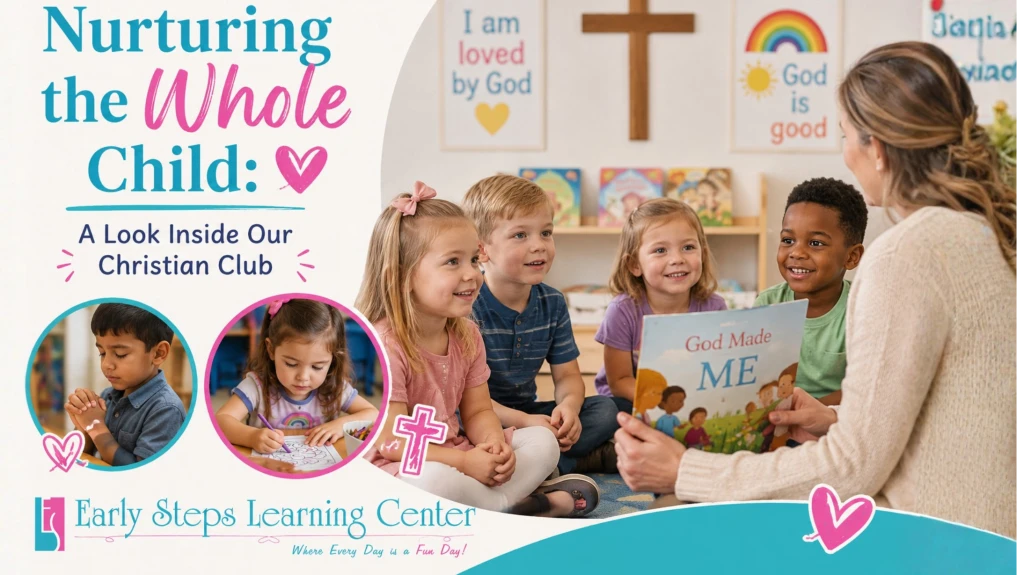
- Special learning opportunities, including Sign Language and an optional Christian Club
Every child develops at their own pace. Our role is to meet children where they are, recognize their strengths and create experiences that help them continue moving forward.
Frequently Asked Questions About Early Brain Development
Does 90% of a child’s brain really develop by age five?
The statement is commonly used to describe how rapidly the brain grows during early childhood. UNICEF sources note that the brain reaches approximately 90% of its adult size by age five. That does not mean learning is 90% complete. The brain continues developing, adapting and forming new connections throughout childhood and adulthood.
Does child care affect brain development?
A high-quality early childhood environment can support healthy development by providing responsive relationships, consistent care, language-rich interactions, active play and age-appropriate opportunities to explore.
What activities help a young child’s brain develop?
Reading, talking, singing, sensory play, pretend play, outdoor movement and predictable routines all support development. Most brain-building experiences happen through everyday play and caring interactions rather than formal lessons or flashcards.
How can I tell whether a preschool supports development?
Ask how teachers build relationships, plan learning experiences, support different developmental levels and communicate with families. Look for children who are actively playing, talking, moving and exploring in a safe, organized environment.
Give Your Child the Strongest Start
The first five years create an important foundation, but parents do not have to navigate them alone.
If you are looking for infant care, toddler care, preschool or before- and after-school care near Richmond Heights or Wickliffe, we would love to show you how Early Steps Learning Center supports children through every stage.
Schedule a tour to meet our teachers, explore our classrooms and learn how purposeful play, nurturing relationships and consistent routines help children grow.
Now Enrolling
Richmond Heights
27027 Chardon Road
(440) 944-2223
Book your Richmond Heights tour
Wickliffe
1601 Drenik Drive
(440) 585-4500
Book your Wickliffe tour
FREE Registration + One FREE Week of Tuition
Restrictions apply.